




Most practice owners hear “med spa marketing” and picture a few Instagram posts and maybe a Google ad. In New York, that mental model will cost you patients every single week. Med spa marketing in New York is the discipline of building a patient acquisition system that works across multiple channels simultaneously — because in this market, a single-channel approach is the equivalent of showing up to a knife fight with a spoon.
At its core, the work breaks down into three interconnected objectives:
- Patient acquisition: Pulling in net-new bookings through search engine visibility, paid advertising, and targeted social campaigns aimed at high-intent prospects in your specific service area
- Patient retention: Converting a first appointment into a long-term relationship through email, SMS, and loyalty structures that keep your treatment calendar full between new patient surges
- Reputation building: Systematically generating reviews, testimonials, and visible before-and-after results that do the persuasion work before a prospective patient ever picks up the phone
What separates New York from every other market isn’t the existence of these three pillars — it’s the execution standard required for each one. Your competitors aren’t mom-and-pop operations running a boosted Facebook post. They’re established practices with dedicated marketing budgets, polished brand identities, and years of accumulated Google reviews. Generic strategy doesn’t survive here. Neighborhood-specific, channel-integrated, compliance-aware marketing does.
New York doesn’t just have competition — it has competition stacked on top of competition, organized by ZIP code. A practice owner on the Upper East Side isn’t fighting one or two rivals for a patient’s attention; they’re competing against dozens of established med spas within a ten-block radius, many of them with six-figure marketing budgets and hundreds of Google reviews already working in their favor.
Three structural realities make med spa marketing in New York categorically harder than anywhere else:
- Aesthetic practice density by ZIP code: Neighborhoods like Midtown, SoHo, and Williamsburg are saturated with providers offering near-identical treatment menus. Visibility isn’t just difficult — it’s expensive to buy and slow to earn organically.
- Rising cost per click and cost per lead: NYC aesthetic keywords routinely command CPCs two to three times higher than national benchmarks. A campaign that breaks even in Phoenix burns through budget fast in Manhattan without disciplined conversion tracking and landing page optimization behind it.
- A high-expectation, tech-savvy patient base: NYC patients research before they book — full stop. They cross-reference reviews on Google, Yelp, and RealSelf, compare injector credentials, and often visit three or four websites before making a call. A weak digital presence doesn’t just underperform here; it actively signals that your practice isn’t worth their time.
These aren’t inconveniences to work around — they’re the baseline conditions every growth strategy has to account for from day one.
Before you build a single campaign, you need an honest picture of who is actually booking appointments at NYC med spas — because the answer is more nuanced than “women who want Botox.”
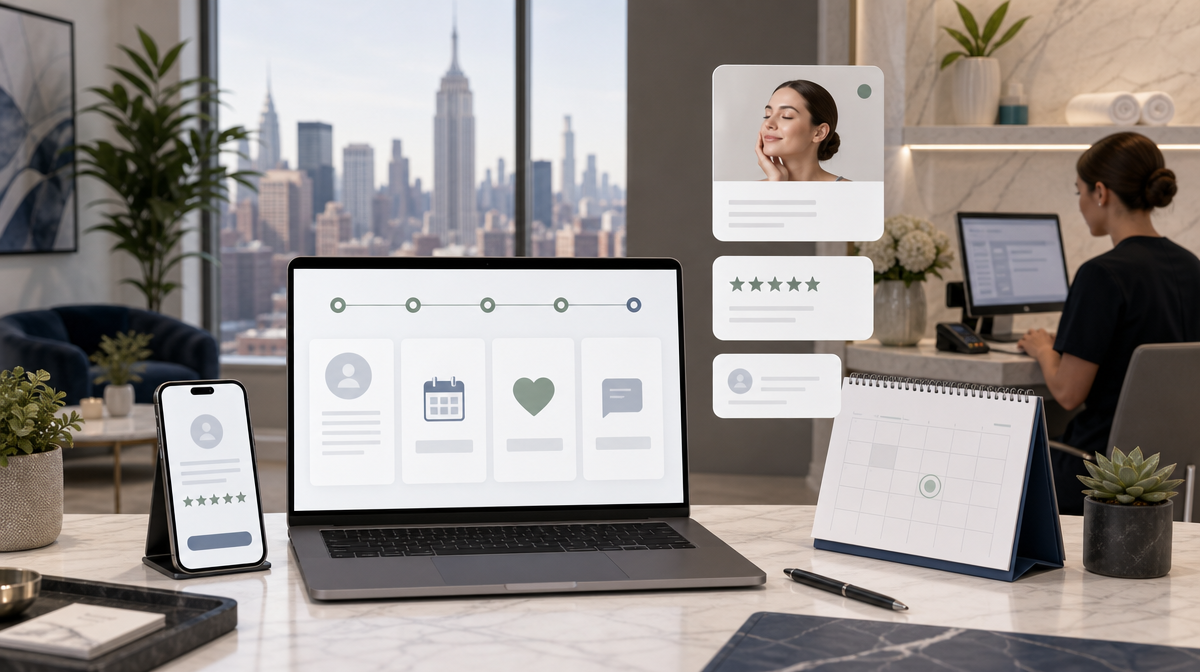
The New York aesthetic patient skews toward four distinct profiles, each requiring a different marketing message to convert:
- The lunch-break optimizer: A 32–48 year old professional in finance, law, or media who has exactly 45 minutes and wants a treatment with zero downtime. She books on her phone, expects instant confirmation, and will not wait on hold. Speed and convenience are the deciding factors.
- The ingredient-conscious researcher: Often wellness-adjacent, she’s already read three Reddit threads about the difference between Sculptra and Radiesse before landing on your website. She responds to clinical authority, provider credentials, and transparent treatment explanations — not vague promises about “looking refreshed.”
- The socially-discovered patient: She found your practice through a TikTok or an Instagram Reel, not a Google search. She’s younger, often booking her first aesthetic treatment, and her trust is built through visual proof and peer validation rather than star ratings.
- The loyal membership seeker: She’s already a med spa patient somewhere — possibly your competitor. She’s looking for a practice that will reward her consistency with pricing that reflects her long-term value.
Effective med spa marketing in New York means building messaging and channel strategies that speak to each of these patients at the moment and platform where they’re actually making decisions.
Standing out in a market this saturated requires a deliberate positioning decision — not better ads, not a prettier website, but a clearly defined reason why a patient in your specific neighborhood should choose you over the practice three blocks away offering the same treatment menu.
- Build a sharp, service-led brand position: The practices that dominate specific NYC neighborhoods aren’t generalists — they’re known for something. “The Sculptra specialists of Tribeca” or “Brooklyn’s go-to clinic for natural-look filler” is a more bookable identity than “full-service med spa.” Owning a specific treatment category or patient outcome gives your marketing a center of gravity that generic competitors can’t replicate.
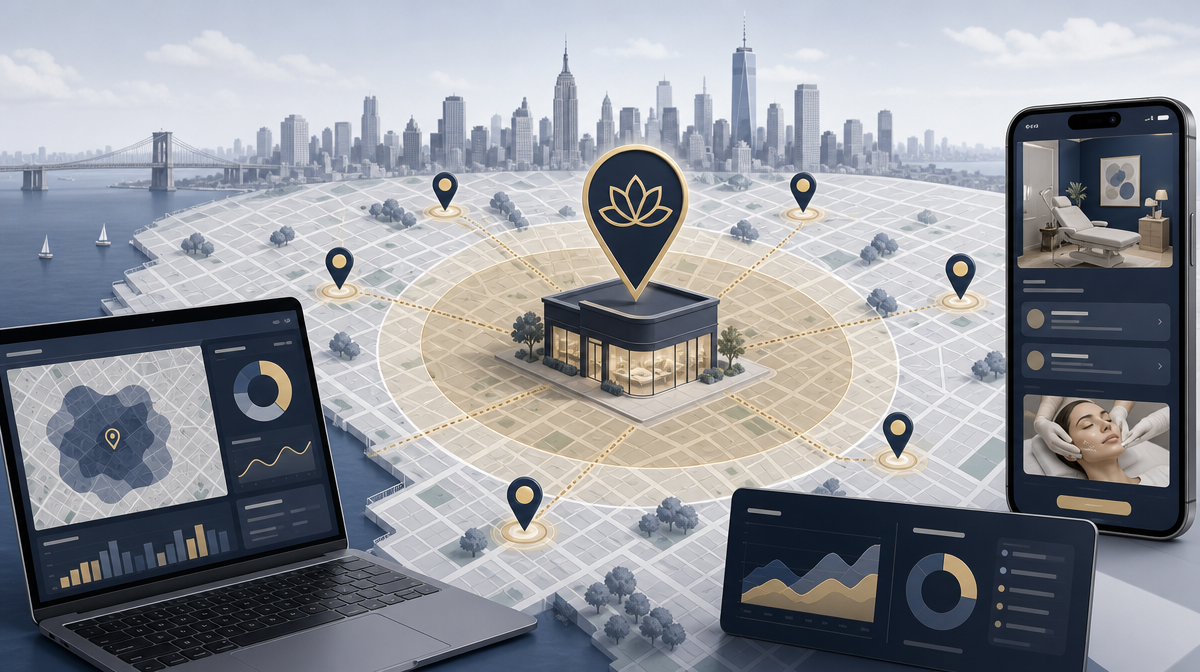
- Own a neighborhood instead of the whole city: Competing for “med spa NYC” puts you against every established practice in all five boroughs. Winning “Botox Flatiron” or “laser treatments Park Slope” is a far more achievable and profitable objective. Hyper-local keyword targeting, neighborhood-specific landing pages, and Google Business Profile optimization tuned to your immediate ZIP code turn geographic proximity into a genuine competitive advantage.
- Productize your signature treatments: Branded treatment packages with clear names, transparent pricing, and bundled outcomes are significantly easier to market — and remember — than a generic service list. A named package signals confidence, simplifies the booking decision, and creates a shareable offer that travels well on social platforms.
- Use social proof as a conversion asset: NYC patients don’t take provider claims at face value. A robust portfolio of documented patient results, posted with proper consent, does more persuasive work than any ad copy. Practices that consistently surface real outcomes — not stock photography — convert at measurably higher rates across every channel.
Think of your marketing stack the way you’d think about a treatment protocol — no single modality does everything, and the best outcomes come from combining the right tools in the right sequence. For med spa marketing in New York, that means five distinct channels working in concert, each covering a gap the others can’t fill alone.
- Conversion-focused website: Your site is where every upstream effort either pays off or collapses. Mobile-first design, sub-three-second load times, inline booking widgets, and procedure-specific pages aren’t nice extras in NYC — they’re the minimum viable standard for a market where patients compare three practices before committing to one.
- Local and organic SEO: A fully optimized Google Business Profile, consistent NAP citations across directories, and dedicated neighborhood landing pages are what move you into the local pack — the three results that capture the majority of clicks on any location-based search.
- Paid search and paid social: Google Ads intercept patients who’ve already decided they want a treatment and are choosing a provider. Meta campaigns build demand earlier in the decision cycle, using visual formats to surface your practice before the search even begins.
- Email and SMS retention: Botox wears off. Filler absorbs. Automated outreach sequences timed to each treatment’s maintenance window keep existing patients rebooking on schedule rather than drifting to a competitor who happened to send a text first.
- Review generation and reputation management: Volume, recency, and professional response cadence across Google, Yelp, and Healthgrades directly influence both search rankings and patient conversion rates — often more than any paid channel.
Search visibility in New York operates on a tiered system — and most med spas are competing at the wrong tier. Bidding for broad terms like “Botox NYC” drops you into a citywide auction where you’re outspent before the day starts. The practices actually winning new patients through organic search are targeting the layer below: treatment-plus-neighborhood keyword combinations that carry genuine commercial intent and far less competition.
Building that visibility requires four coordinated moves:
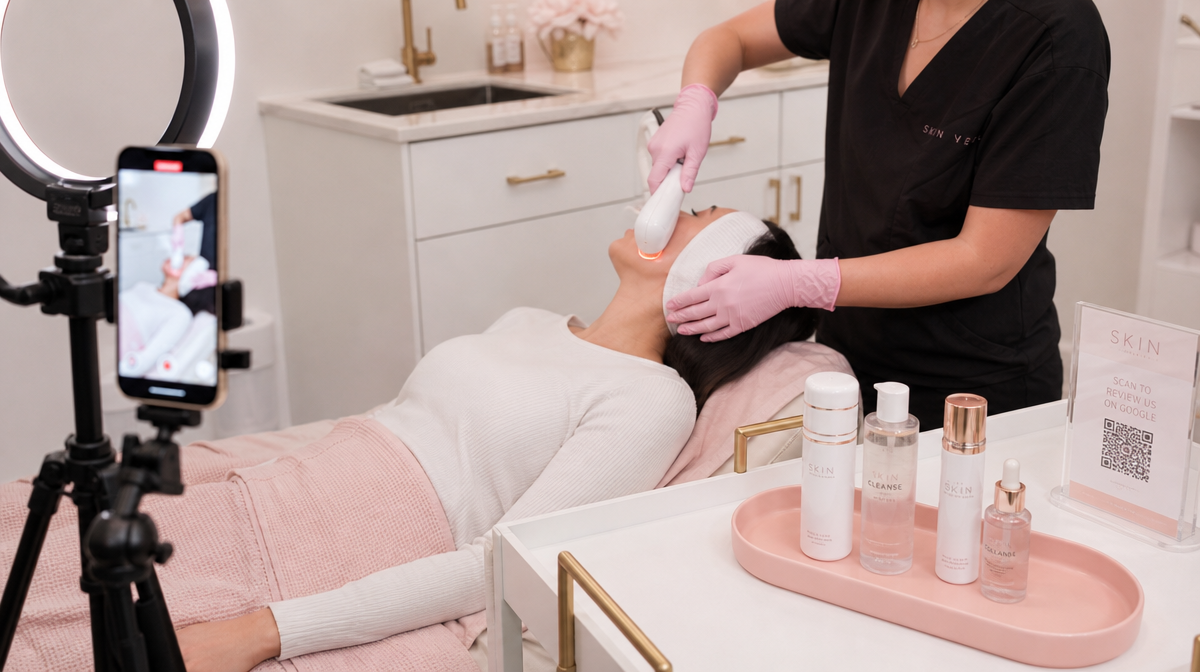
- Neighborhood-plus-treatment keyword targeting: Phrases like “lip filler Astoria” or “laser resurfacing Chelsea” capture patients who have already narrowed their search geographically — meaning they’re closer to booking and easier to convert than someone still browsing at the city level.
- Dedicated service landing pages with local anchors: A single “services” page cannot rank for twenty different treatment searches across ten neighborhoods. Each core treatment deserves its own page, built around the specific terms patients in that ZIP code are actually typing.
- Google Business Profile as an active asset: Your GBP is not a set-it-and-forget-it directory listing. Regular photo uploads, treatment-specific service categories, active Q&A management, and weekly posts all factor into local pack placement — the map results that dominate mobile searches for nearby providers.
- Blog content mapped to patient questions: Patients researching “how long does Sculptra last” or “what to expect after microneedling” are in active consideration mode. Content that answers those questions positions your practice as the credible authority before they’ve decided who to call.
Technical foundations matter too — crawlable site architecture, schema markup for medical businesses, and page speed scores that meet Google’s Core Web Vitals thresholds all determine whether your content earns rankings or simply exists on the web.
High CPCs are a feature of the NYC market, not a bug you can optimize away — so the question isn’t how to avoid expensive clicks, but how to make sure every click you pay for has a realistic path to a booked appointment. That distinction separates profitable paid campaigns from expensive traffic reports.
The structural decisions that determine profitability in a high-cost market come before anyone sees your ad:
- Geo-targeting at the borough or ZIP level: Campaigns set to “New York City” bleed budget across geographies where your proximity is irrelevant. Constraining delivery to the two or three ZIP codes where patients are actually willing to travel for your specific treatments dramatically improves your cost per acquisition.
- Negative keyword lists built for aesthetics: Searches like “med spa jobs,” “med spa franchise cost,” and “DIY Botox” consume real money if you’re not actively excluding them. A well-maintained negative list can cut wasted spend by 20–30% in a competitive market without touching your reach among genuine prospects.
- Procedure-matched landing pages: Sending Google Ads traffic to a homepage is a conversion killer. Patients who clicked on a CoolSculpting ad expect a CoolSculpting page — with pricing signals, outcome photos, and a booking option that doesn’t require three more clicks to reach.
- Retargeting for the consideration window: NYC aesthetic patients rarely book on a first visit. Meta retargeting campaigns that stay in front of site visitors for 14–21 days after initial contact recover a meaningful percentage of prospects who were genuinely interested but not ready to commit immediately.
NYC’s visual culture makes social media a uniquely powerful patient acquisition channel — but only if you treat it as a booking engine rather than a highlight reel. The practices filling appointment slots through Instagram and TikTok aren’t simply posting pretty content; they’re engineering a conversion path from first scroll to confirmed booking.
What actually moves NYC aesthetic patients on social platforms:
- Instagram Reels showcasing real treatment experiences: Short-form video of the actual injection process, the consultation room, or a patient’s genuine reaction captures authenticity that polished stock imagery never can. NYC audiences are visually sophisticated — they spot inauthenticity immediately and scroll past it just as fast.
- TikTok for treatment discovery among first-time patients: A significant portion of younger NYC patients learn about treatments like Sculptra or PRF entirely through TikTok before they ever search on Google. Educational content that demystifies a procedure — without being clinical or sterile — positions your practice as the obvious next step.
- User-generated content as earned trust: When a patient tags your Williamsburg or Midtown location in their own post, that content carries more credibility than anything your marketing budget can produce. Systematically encouraging tags and shares after positive treatment experiences compounds your organic reach without compounding your spend.
- Micro-influencer partnerships with genuine local followings: A Manhattan-based lifestyle creator with 12,000 engaged followers who actually live in your service area outperforms a national influencer with 500,000 followers who has never been to your ZIP code.
Paid Meta campaigns layered on top of this organic foundation let you retarget engaged viewers with direct booking offers — turning passive interest into scheduled appointments.
In a city where patients have forty viable alternatives within a ten-minute subway ride, your review profile isn’t a nice-to-have — it’s the difference between a full calendar and an empty waiting room. NYC patients treat online feedback as a pre-qualification filter, not a tiebreaker — 84% check reviews before choosing a healthcare provider. A practice with 23 reviews and a 4.2 average loses business to the one with 187 reviews and a 4.8 average before either practice has spoken to the patient directly.
The gap between practices that dominate local reputation and those that struggle almost always comes down to process, not patient satisfaction. Happy patients don’t leave reviews by default — 74% would if simply asked — but they need a frictionless prompt at exactly the right moment. A well-timed post-appointment text sent within 24 hours, when the patient is still pleased with their results, converts at dramatically higher rates than any follow-up sent days later.
Running a complete reputation system for med spa marketing in New York means covering more ground than just Google:
- Automated review requests: Post-appointment SMS and email sequences that reduce the action to two taps — anything more complicated and completion rates collapse
- Professional responses to every review: Thanking positive reviewers publicly signals attentiveness; addressing critical feedback calmly demonstrates clinical maturity that prospective patients notice
- On-site review display: Embedding verified patient feedback directly on your service pages removes friction at the exact moment a visitor is deciding whether to book
- Multi-platform monitoring: RealSelf and Healthgrades attract patients specifically researching aesthetic procedures — your absence from those platforms quietly redirects their bookings to competitors who showed up
The search landscape your patients use to find med spas is being rewritten in real time — and the practices that recognize this shift first will capture patient flow that their competitors don’t even know they’re losing. Google’s AI Overviews now surface synthesized answers directly in search results for treatment queries — Ahrefs data shows a 58% drop in click-through rates for top-ranking pages — meaning a patient searching “best Botox clinic Upper East Side” may never scroll to the traditional blue links at all. If your practice isn’t structured to appear inside those AI-generated summaries, you’re invisible to a growing segment of high-intent searchers.
This is where Generative Engine Optimization — GEO — becomes a practical concern for your practice, not just a marketing buzzword.
Three capabilities are shifting how med spa marketing in New York actually generates patient volume right now:
- Generative Engine Optimization (GEO): Formatting treatment content with clear, factual authority signals so Google’s AI Overviews and ChatGPT cite your practice when patients ask procedure questions
- AI-powered predictive targeting: Systems like Target Patients MD’s A.L.I. 360 analyze behavioral signals across channels to concentrate your ad spend on the prospect segments statistically most likely to book — reducing wasted impressions without shrinking your reach
- 24/7 AI scheduling: An NYC patient researching treatments at midnight won’t wait until your front desk opens Monday morning — automated chat captures that intent before it expires
The agency you hire for med spa marketing in New York will either accelerate your growth or quietly drain your budget while producing activity reports that look nothing like a booked appointment calendar. Choosing correctly comes down to three criteria that most practice owners don’t think to ask about until they’ve already signed the wrong contract.
- Healthcare-only specialization: Ask any prospective agency how they handle HIPAA-compliant pixel configurations on booking forms, and watch what happens. A generalist will pause. A healthcare-specialized firm will answer without hesitation — because they’ve already solved that problem for dozens of practices. Aesthetic medicine has specific regulatory exposure, patient decision timelines, and platform nuances that a firm splitting attention between med spas and restaurant chains will consistently mishandle.
- Transparent reporting tied to actual patients: Dashboards that show impressions, clicks, and follower counts are not performance reporting — they’re distraction. Insist on attribution that connects specific campaigns to phone calls, form submissions, and booked appointments. If an agency can’t show you cost-per-acquisition by channel, they don’t have the measurement infrastructure to improve it.
- Performance guarantees and month-to-month flexibility: Any agency confident enough in their results for the New York market should be willing to structure accountability into the agreement itself — not buried in a renewal clause after month twelve. Multi-year lock-ins protect the agency, not your practice. Look for terms where the agency’s compensation is meaningfully tied to patient delivery, not just campaign activity.
Target Patients MD was built with one patient type in mind: yours. Unlike generalist firms that split attention across e-commerce brands, restaurants, and law firms, every system we operate — from campaign architecture to reporting dashboards — was designed specifically for medical practices competing in healthcare’s most demanding markets.
For NYC med spa owners specifically, that means you’re not funding someone else’s learning curve. We’ve already mapped the patient acquisition patterns, neighborhood-level conversion differences, and compliance requirements that determine whether a New York aesthetic practice grows or stagnates. That institutional knowledge is baked into every campaign we launch on your behalf.
What working with Target Patients MD actually looks like for your practice:
- A.L.I. 360 AI technology: Proprietary machine learning that continuously refines targeting across every active channel, delivering patient acquisition lifts that manual campaign management can’t match
- ZIP-code-level strategy: Your Tribeca location and a Astoria competitor require entirely different positioning — we build campaigns that reflect those differences, not a template applied citywide
- Integrated channel management: SEO, paid ads, reputation systems, and retention campaigns coordinated as a single patient acquisition engine — not a collection of disconnected vendors billing separately
Book a free strategy consultation at targetpatientsmd.com and get a clear picture of what a purpose-built med spa marketing system looks like for your specific practice, location, and growth goals.
If you’re weighing whether med spa marketing in New York makes financial sense for your practice, these are the questions most owners ask before committing to a strategy.
- How much does med spa marketing in New York typically cost? Monthly investment varies considerably based on your service mix, neighborhood competitiveness, and growth targets. A single-location practice in a moderately competitive borough operates on a different budget than a multi-treatment clinic pursuing dominant Manhattan placement. Because NYC ad costs run significantly above national averages, expect your total investment — spanning paid media, SEO, and reputation infrastructure — to reflect that premium. A free strategy consultation is the most accurate way to size your specific budget requirements.
- How long before a New York med spa sees new patient bookings from marketing? Paid campaigns typically generate inbound inquiries within the first few days of going live. Organic search visibility builds more gradually — meaningful ranking improvements and traffic gains generally emerge over several months as domain authority accumulates. Most practices see measurable new patient activity within the first few weeks when paid and organic channels launch in parallel.
- Is social media or SEO more effective for marketing a med spa? They serve fundamentally different functions. SEO captures patients who are already searching for a specific treatment and selecting a provider. Social media surfaces your practice to patients who haven’t started searching yet, building the familiarity and visual trust that eventually drives them to look you up.
- Can a new med spa compete in Manhattan with a limited marketing budget? Yes — by narrowing focus rather than spreading thin. Concentrating on one neighborhood, a tight set of signature treatments, and zero-cost trust-builders like Google Business Profile optimization and systematic review generation creates a foundation that paid campaigns can scale from once revenue supports the investment.


