

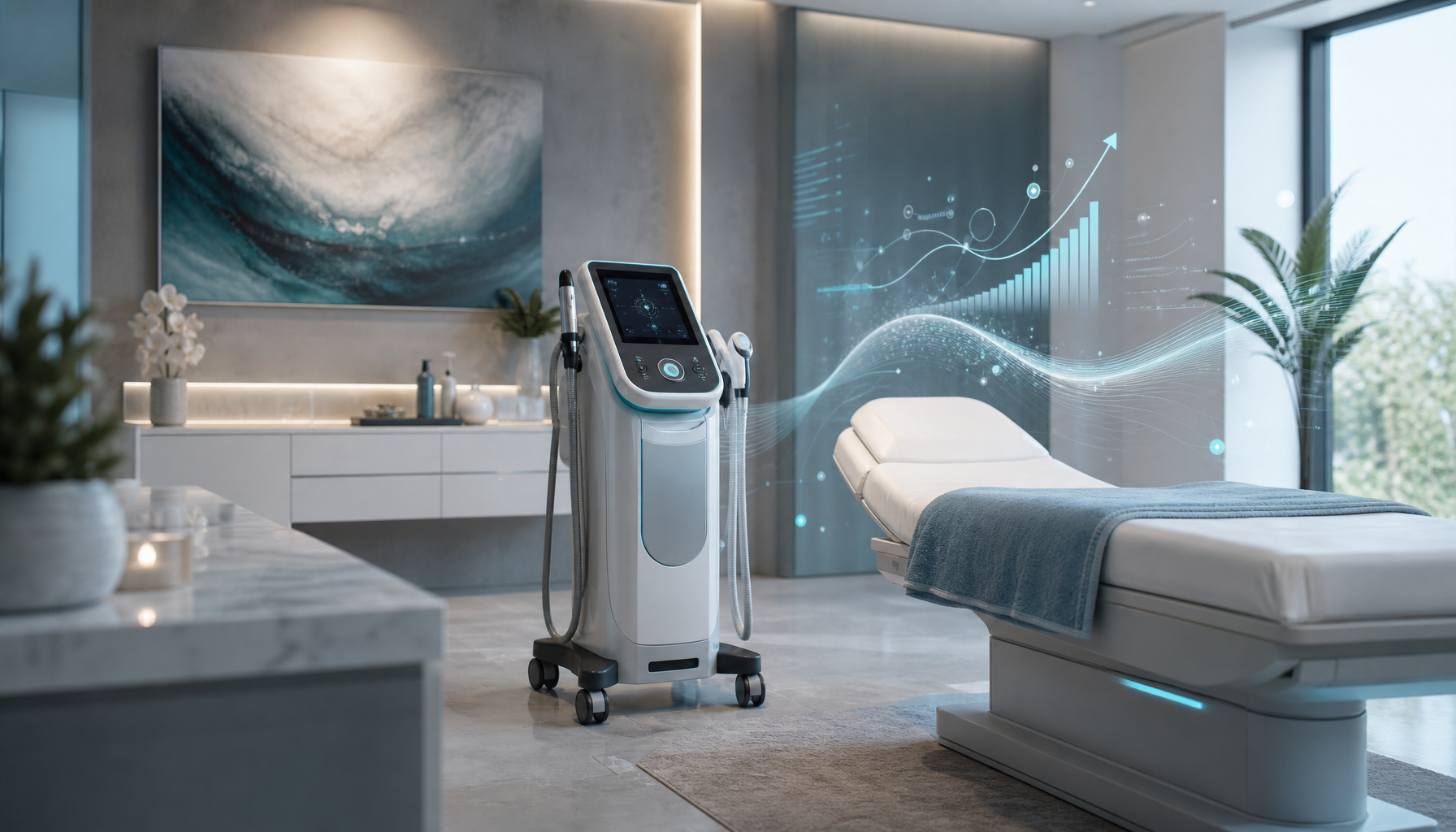
Most practices that invest in Emsculpt or Emsculpt NEO make the same marketing mistake: they lead with the technology. HIFEM. Radiofrequency. Supramaximal contractions. These terms mean something to your clinical team — they mean almost nothing to the patient scrolling Instagram at 10pm wishing her arms looked different in photos.
Effective emsculpt marketing doesn’t sell a device. It sells a specific, desirable physical outcome — and it speaks to the exact moment a patient decides she’s done accepting the body she has. That might be a wedding on the calendar, a milestone birthday, or simply hitting a plateau after months of effort at the gym.
What patients are actually buying when they book a series:
- Visible abdominal definition without surgery or a six-week recovery
- A lifted, firmer buttocks that responds the way exercise alone stopped doing years ago
- Toned arms and thighs they feel confident showing off
- No downtime — they can walk out and pick up their kids from school
Emsculpt NEO adds one more compelling angle: it’s the only non-invasive treatment that simultaneously reduces fat and builds muscle in the same 30-minute session. That dual benefit is your marketing headline, not a footnote. Lead with what the patient sees in the mirror three months from now, and the technology becomes proof — not the pitch.
The standard Emsculpt protocol — four sessions spaced five to ten days apart — is not just a clinical recommendation. It’s the most important number in your revenue model, and most practices undermine it by marketing individual sessions instead of the complete series.
Here’s why that matters financially: a single session booked at $300–$400 barely covers your overhead on a $150,000+ device. A four-session series booked at $2,400–$3,200 changes the economics entirely. Multiply that across 10 new patients per month and you’re looking at a meaningful difference in monthly revenue before a single maintenance appointment is counted.
Beyond the immediate transaction, series completion drives two compounding outcomes that single-session sales never produce:
- Better clinical results — patients who complete all four sessions see the measurable muscle and fat changes that generate referrals. Patients who stop after session one rarely become advocates.
- Lifetime value acceleration — a patient who achieves visible results at the end of a series is a natural candidate for maintenance sessions, additional treatment areas, and complementary services your practice already offers.
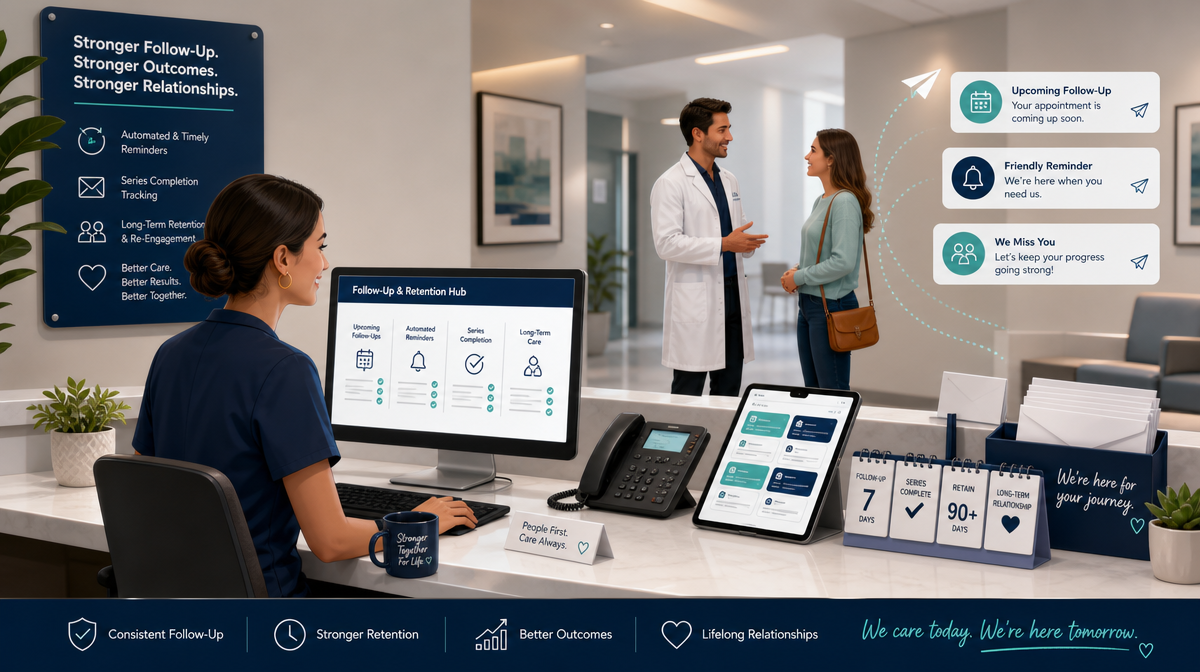
Effective emsculpt marketing therefore starts at the series level, not the session level. Your ads, your landing page, and your consultation script should all anchor to the complete package — its pricing, its timeline, and the specific outcome patients can expect when they finish. That framing shapes who books and how committed they are when they walk through your door.
Not every practice extracts equal value from emsculpt marketing — and with the body contouring devices market projected to reach $5.28 billion by 2034, understanding where you fit shapes how aggressively you should invest. The practices that generate the strongest ROI share one trait: they already have a patient base with body-contouring intent, which means shorter education cycles and faster conversion from inquiry to booked series.
- Med spas and aesthetic clinics: The natural home for Emsculpt. Your existing clientele is already spending on appearance-focused treatments, which makes upselling a series far easier than cold acquisition. Bundling Emsculpt with injectables, laser treatments, or skin tightening creates package revenue that individual treatment marketing simply cannot match.
- Plastic surgery practices: Surgical candidates who aren’t ready to commit — or who want to enhance their post-op results — are ideal Emsculpt patients. It functions as both a revenue bridge and a relationship builder that keeps prospective surgical patients in your ecosystem longer.
- Dermatology practices: Emsculpt NEO slots naturally alongside radiofrequency skin tightening and body treatment protocols already on your menu, giving patients a more complete body transformation without requiring a separate provider relationship.
- GLP-1 and medical weight loss clinics: This is the fastest-growing opportunity in body contouring right now. Patients on Ozempic or Wegovy are losing weight rapidly, but recent trials show 26–40% of weight lost is lean mass — a problem Emsculpt NEO directly addresses. ASPS data shows 41% of GLP-1 patients are considering nonsurgical procedures, and very few practices have built a focused GLP-1 marketing strategy yet.
Not every channel moves the needle equally for body contouring — and spreading your budget thin across every platform is how practices end up with a lot of activity and very few booked series. The channels that consistently outperform for Emsculpt marketing share a common trait: they reach patients at the exact moment intent is highest.
- Google Search Ads: Someone typing “Emsculpt near me” or “body contouring [city]” has already decided they want this treatment — they’re just choosing a provider. These searches convert faster and require less persuasion than almost any other traffic source. This is where your first marketing dollar should go.
- Meta Ads: Facebook and Instagram won’t capture ready-to-book patients the way search does, but they’re unmatched for building awareness among women aged 30–55 who follow fitness and aesthetics content. Compliant before-and-after creative paired with lead generation campaigns fills your consultation pipeline before those patients ever search Google.
- Local SEO: Ranking in the Google Map Pack for “Emsculpt near me” queries delivers high-intent clicks at zero cost per click. Your Google Business Profile, location-specific pages, and reviews mentioning Emsculpt by name all feed this ranking.
- Email and SMS: For your existing patient base, this channel routinely outperforms every paid option on cost per booked series. Maintenance cycles, seasonal promotions, and reactivation campaigns run on near-zero ad spend.
| Channel | Best For | Typical Lead Quality |
|---|---|---|
| Google Search Ads | High-intent buyers ready to book | Highest |
| Meta Ads | Awareness and lead generation | Medium-High |
| Local SEO | “Near me” searches | High |
| Email/SMS | Repeat bookings and reactivation | Highest (existing patients) |
Your ad budget is only as effective as the page it sends traffic to. Practices that route Emsculpt clicks to their homepage or general services page consistently see conversion rates drop — because a homepage answers a dozen questions at once, and a patient ready to book a body contouring series needs exactly one thing: confirmation that she’s in the right place.
A dedicated Emsculpt landing page outperforms generic pages because it eliminates the decision fatigue that kills conversions. Every element on the page should serve a single outcome: a consultation booked.
- Lead with the dual benefit: Emsculpt NEO is the only non-surgical treatment that builds muscle and reduces fat simultaneously. Open with that statement in patient language — not clinical terminology.
- Place before-and-after photos above the fold: Visual proof converts faster than any headline. If you don’t have your own patient photos yet, BTL provides manufacturer images you can use with proper disclaimers.
- Explain the mechanism simply: “The equivalent of 20,000 crunches in 30 minutes” communicates more than “supramaximal HIFEM contractions.” Plain language keeps patients engaged instead of confused.
- Show all treatable areas: Patients frequently search for specific body parts — abs, glutes, arms, calves. Listing each area with corresponding images captures those searches and expands perceived value.
- Address cost directly: Providing a starting price or package range pre-qualifies visitors and reduces consultations that go nowhere.
- Add an inline booking form: Every click required between intent and scheduling loses you a patient. Online scheduling with a phone number as backup removes that friction entirely.
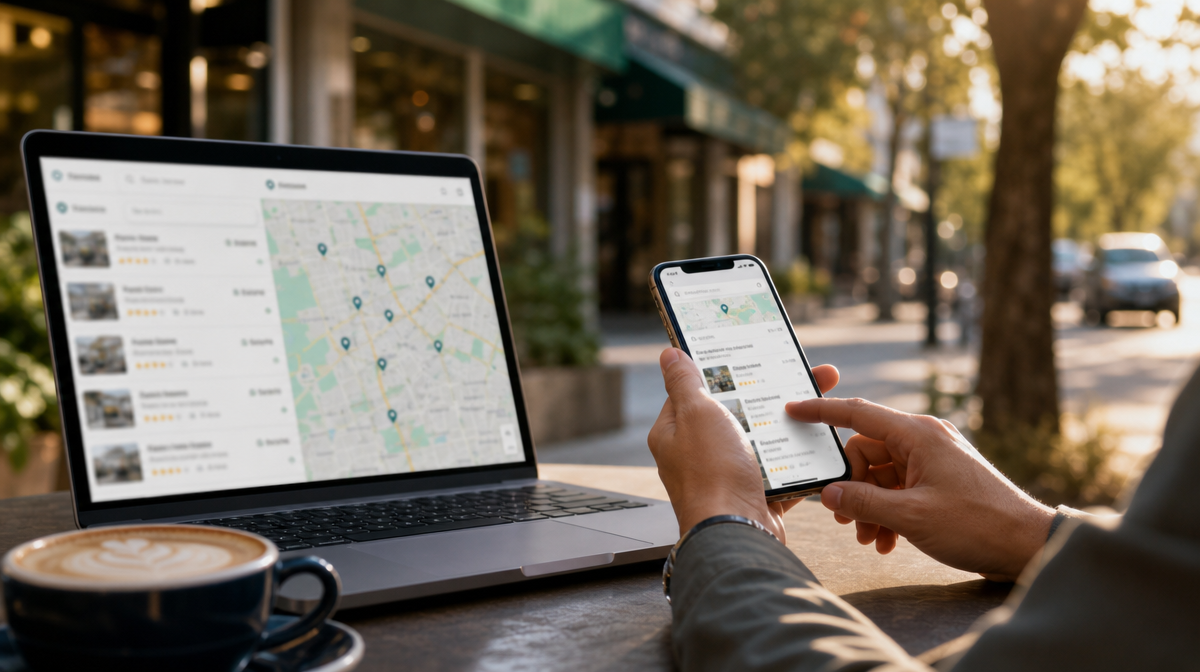
When a patient in your city opens Google and types “Emsculpt near me,” she’s not browsing — she’s ready to pick up the phone. Capturing that search is a local SEO problem, and it breaks down into four specific actions your practice can take right now.
- Google Business Profile optimization: Add Emsculpt and Emsculpt NEO as named services inside your profile — not just in the description, but in the dedicated services section. Upload treatment photos with descriptive file names, post monthly updates about your body contouring offerings, and respond to every review within 48 hours. Practices that treat their GBP as a living asset consistently outrank those that set it and forget it.
- Location-specific landing pages: If you serve multiple zip codes, neighborhoods, or suburbs, each location deserves its own page. A page titled “Emsculpt NEO in [Neighborhood Name]” captures hyper-local searches that a single city-level page will miss entirely.
- Review generation with treatment-specific language: Ask satisfied patients to mention Emsculpt by name when leaving a review. Google indexes review content, and a review that reads “I completed my Emsculpt series here and saw real results” carries more local ranking weight than a generic five-star comment.
- NAP consistency across directories: Your practice name, address, and phone number must match exactly across Healthgrades, Yelp, RealSelf, and every other directory where you’re listed. Inconsistent citations create conflicting signals that suppress your map pack ranking regardless of how well everything else is optimized.
Ranking in the map pack for body contouring searches puts your practice in front of patients who have already made a decision — they’re just choosing between you and the clinic down the street.
Before-and-after photos are the single highest-converting asset in any emsculpt marketing campaign — and also the fastest way to get your ads rejected, your account flagged, or your practice exposed to a liability claim if you use them carelessly.
The good news: BTL provides a library of manufacturer-approved clinical photos that any licensed provider can use in marketing materials. These images come with the documentation trail already established, which matters when Meta or Google reviews your creative. If you’re just launching your Emsculpt program and haven’t yet photographed your own patients, start here rather than skipping visuals entirely.
When you do begin capturing your own patient photos, these are the non-negotiable requirements:
- Written informed consent: Obtain a signed photo release that explicitly covers digital marketing, social media, and paid advertising — not just general promotional use.
- Standardized photography conditions: Consistent lighting, distance, and patient positioning between before and after shots. Inconsistency reads as manipulation even when results are genuine.
- “Results may vary” disclaimers: Required on every image, every platform, without exception — including organic social posts.
- Meta-specific restrictions: Facebook and Instagram prohibit imagery that depicts idealized body types or implies guaranteed outcomes. Frame your creative around realistic transformation, not perfection.
Platforms audit aesthetic ads more aggressively than almost any other category. A single non-compliant image can pause your entire ad account mid-campaign — which is a particularly painful problem when you’re running a limited-time series promotion.
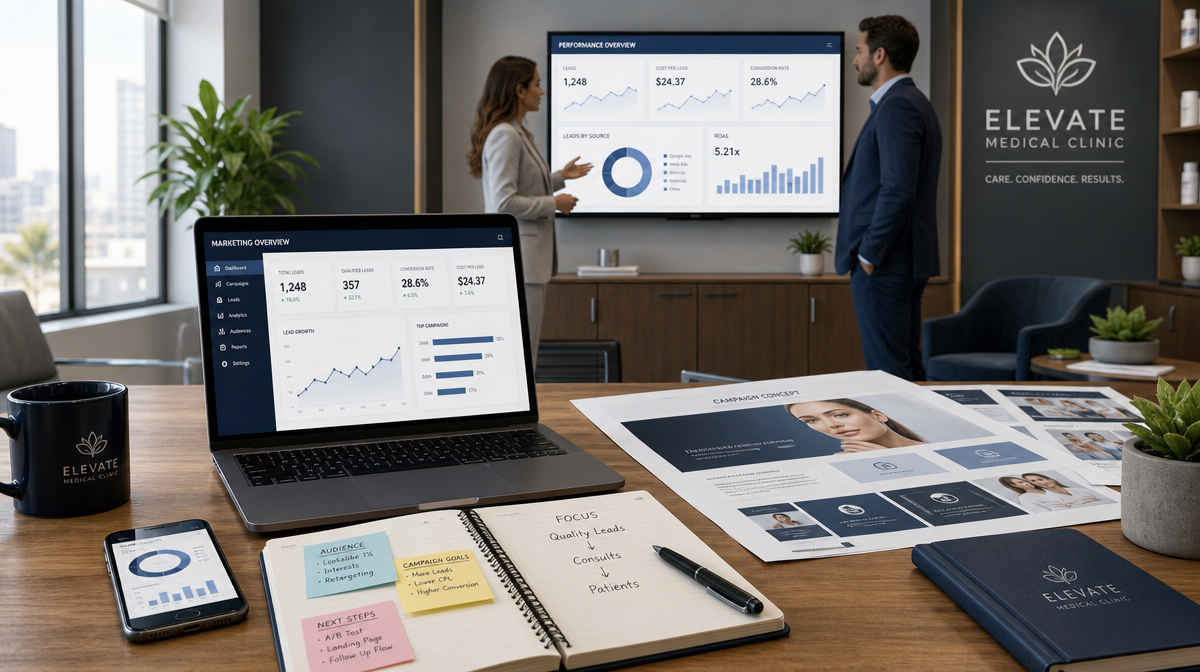
Pricing structure is where most practices quietly lose series completion — not in the marketing, but in the offer itself. When every session is priced identically as a standalone unit, patients feel no financial reason to commit upfront, which means they book one appointment, see early soreness, and ghost you before results develop.
The packaging strategies that actually move full series commitments work like this:
- Series pricing with a visible discount: Display the per-session rate alongside the four-session package price so the savings are explicit. A patient who sees “$800 per session / $2,800 for the complete series” does the math instantly — and the package wins.
- Maintenance packages at loyalty pricing: Offer three- and six-month follow-up sessions at a reduced rate, available only to patients who completed a full series. This creates a retention incentive built into the original purchase decision.
- Financing on the landing page and in ads: Many qualified Emsculpt patients hesitate not because they’re uninterested but because $2,800–$3,200 upfront feels like a commitment. Mentioning CareCredit or similar options directly in your ad creative removes that objection before the consultation ever happens.
- Combination bundles for higher average ticket: Pairing Emsculpt with a complementary service — skin tightening, lymphatic drainage, or body contouring wraps — increases the total transaction without requiring a separate acquisition effort for each add-on.
Publishing a starting price in your emsculpt marketing also filters your leads. Patients who reach your consultation already knowing the approximate investment are dramatically more likely to book on the spot.
Most practices leave a significant portion of their Emsculpt revenue sitting in unopened texts and ignored follow-up windows. The consultation happens, the patient leaves impressed, and then… silence. No systematic outreach, no urgency, no structured pathway from “I’m interested” to “I’ve paid for my series.” That gap is where series bookings go to die.
- Post-consultation package offer (within 24 hours): Strike while the treatment room excitement is still fresh. A same-day or next-morning message that includes a limited-time series rate — even a modest discount that expires in 48 hours — converts consultations that would otherwise require three more touchpoints to close.
- Session reminder and prep sequence: Automated reminders sent 24 hours before each appointment should include practical prep guidance: hydration instructions, what clothing to wear, and what physical sensations to expect. Patients who feel prepared show up. Patients who feel uncertain reschedule indefinitely.
- Between-session motivation messages: The two-week treatment window is when patients are most vulnerable to dropping off. A short message after sessions one and two that explains exactly what’s happening in their muscles — and sets realistic expectations for when visible changes typically appear — keeps them mentally committed through the soreness phase.
- Post-series maintenance and rebooking campaign: Schedule automated outreach at the 90-day and 180-day marks after series completion. Offer returning patients a loyalty rate on maintenance sessions and reference the specific results they achieved. Personalized reactivation consistently outperforms any new patient acquisition campaign on a cost-per-booked-appointment basis.
Something shifted in patient search behavior over the last two years that most practices haven’t caught up with yet. A growing number of prospective Emsculpt patients aren’t opening Google and typing keywords — they’re asking ChatGPT, Gemini, or Google’s AI Overview a direct question: “Where can I get Emsculpt NEO near me?” or “What’s the best body contouring clinic in [city]?” The AI answers. And if your practice isn’t structured to be cited by those systems, you’re invisible to an entire emerging patient segment.
This is what Generative Engine Optimization (GEO) addresses. Unlike traditional SEO, which optimizes for ranked links, GEO structures your content so that AI assistants can extract, trust, and recommend your practice directly inside their generated responses. Search Engine Land’s GEO guide notes that AI-cited sources share specific structural characteristics — clear service definitions, geographic specificity, and authoritative supporting detail — that most practice websites currently lack.
Beyond how patients find you, AI is also changing how your marketing dollars get spent. Practices running Emsculpt campaigns through AI-powered ad platforms now benefit from predictive lead scoring — systems that identify which inquiries are statistically likely to convert into paid series before your front desk ever picks up the phone. That means your team spends consultation time on high-probability patients rather than educating people who were never going to commit.
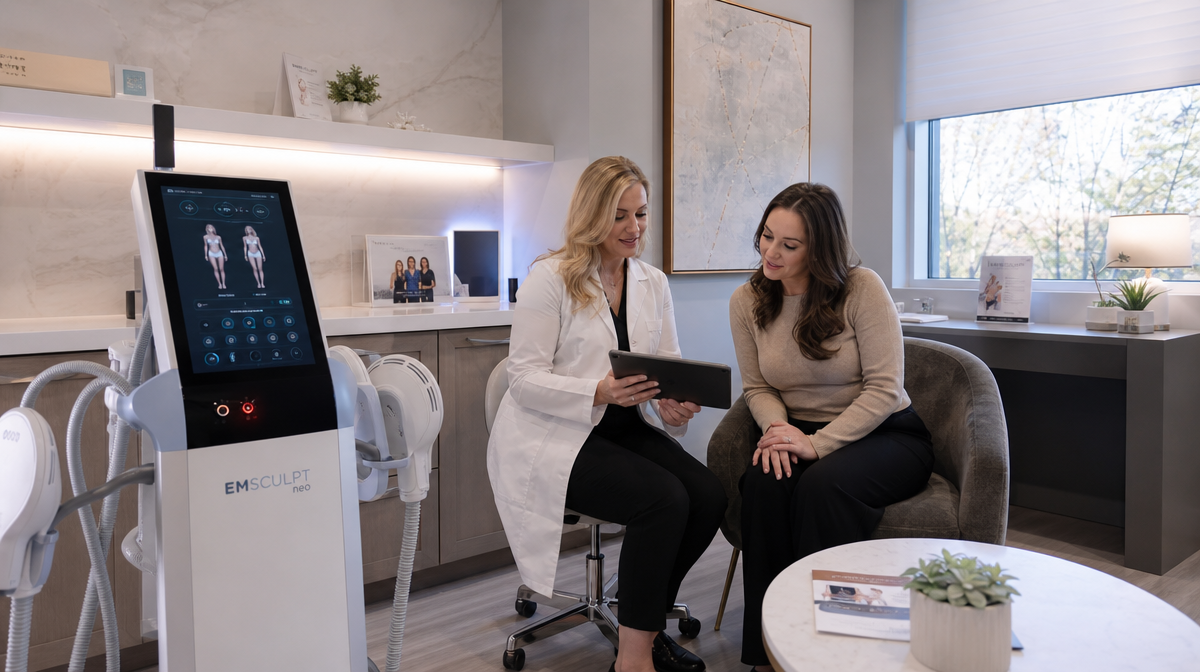
- Structure service pages for AI citation: Include explicit answers to questions like “What does Emsculpt treat?” and “How many sessions are required?” in plain, quotable language
- Add geographic specificity throughout: City, neighborhood, and regional references help AI systems match your practice to location-based queries
- Use AI ad optimization tools: Platforms that automatically reallocate budget toward converting audience segments reduce wasted spend without requiring manual campaign monitoring
Running Emsculpt campaigns while managing a full patient schedule is where most practices hit a wall. The marketing knowledge exists somewhere — between your front desk coordinator, a part-time social media person, and whatever your BTL rep suggested at the last training — but none of it connects into a system that reliably puts new series on the books each week.
Target Patients MD was built specifically for this gap. We work exclusively with medical practices — med spas, aesthetic clinics, plastic surgery offices, and weight loss providers — and our entire focus is booked appointments, not impressions or click-through rates that look good in a report but don’t translate to revenue.
What makes the difference for Emsculpt practices specifically:
- A.L.I. 360 AI technology that continuously optimizes your ad spend across channels, shifting budget toward the audience segments and search queries that are actively converting — without requiring your team to monitor dashboards manually
- Fully managed campaign execution across Google, Meta, and local SEO, built around the full four-session series commitment rather than individual treatment promotions
- Deep aesthetic practice experience across 735+ medical practitioners, which means we understand body contouring patient behavior, compliance requirements, and what creative actually drives consultations in your market
If your Emsculpt device is underperforming its potential, the problem is almost never the treatment itself. Learn more about Target Patients MD and what a purpose-built emsculpt marketing system looks like in practice.
Emsculpt marketing raises a consistent set of questions from practice owners — and the answers often determine whether a campaign breaks even or becomes a reliable revenue driver. Here are the ones that come up most frequently.
- How much should a practice spend on Emsculpt marketing each month? Start with a budget that allows parallel testing on both Google and Meta rather than committing everything to one channel. Scale based on your cost per booked consultation, not your cost per click. The right number depends entirely on how many new series your schedule can absorb each month.
- What is a good cost per lead for Emsculpt body contouring? Cost per lead is the wrong metric to optimize for. A $25 lead that never books is more expensive than a $120 lead that purchases a full series. Track lead-to-consultation rate and consultation-to-booked-series rate — those numbers tell you whether your campaign is actually working.
- How long does Emsculpt marketing take to generate new patients? Paid search and social campaigns typically produce consultation requests within the first week of launching. Organic local search improvements take longer — usually three to six months before ranking movement becomes meaningful.
- Should Emsculpt marketing compete directly with CoolSculpting? Positioning them as competing treatments wastes ad spend. Muscle building and fat reduction serve different patient goals, and many practices profitably market both — letting the consultation determine which treatment fits.
- Is it better to hire an agency or run Emsculpt campaigns in-house? In-house execution works when you have a dedicated staff member with time to optimize continuously. Without that capacity, a specialized medical marketing agency with aesthetic experience typically delivers stronger ROI faster.